Two-String DP — dfs(i, j) Pattern
Problem List
| # | Problem | LeetCode | Difficulty |
|---|---|---|---|
| 1 | Longest Common Subsequence | https://leetcode.com/problems/longest-common-subsequence/ | Medium |
| 2 | Interleaving String | https://leetcode.com/problems/interleaving-string/ | Medium |
| 3 | Distinct Subsequences | https://leetcode.com/problems/distinct-subsequences/ | Hard |
| 4 | Edit Distance | https://leetcode.com/problems/edit-distance/ | Medium |
| 5 | Wildcard Matching | https://leetcode.com/problems/wildcard-matching/ | Hard |
| 6 | Regular Expression Matching | https://leetcode.com/problems/regular-expression-matching/ | Hard |
Core Pattern
Most of these problems can be expressed as:
dfs(i, j)where i and j represent positions in two strings, or a string and a pattern.
The main question at every state:
Do the current characters match? If yes/no, which pointer(s) should move?
Memoizing (i, j) generally gives O(m × n) states.
1. Longest Common Subsequence — LC 1143
State
dfs(i, j)Length of the LCS between text1[i:] and text2[j:].
Transition
If characters match:
1 + dfs(i + 1, j + 1)Otherwise, skip one character from either string:
Math.max(
    dfs(i + 1, j),
    dfs(i, j + 1)
)
Base case
if (i === s1.length || j === s2.length)
    return 0;
Remember
match    → take it, move both
no match → skip from either side
Complexity: O(m × n)
2. Interleaving String — LC 97
Given s1, s2, determine whether they can be interleaved to create s3.
State
dfs(i, j)i = position in s1
j = position in s2
Position in s3 is automatically:
k = i + jTransition
Try taking from s1:
if (s1[i] === s3[i + j])
    dfs(i + 1, j)
Try taking from s2:
if (s2[j] === s3[i + j])
    dfs(i, j + 1)
If either works → true.
Important optimization
Immediately reject:
if (s1.length + s2.length !== s3.length)
    return false;
Remember
s3[k]
  ↓
Can I take s1[i]?
OR
Can I take s2[j]?
Complexity: O(m × n)
3. Distinct Subsequences — LC 115
Count how many subsequences of s equal t.
State
dfs(i, j)Number of ways s[i:] can produce t[j:].
If characters match
Two choices:
dfs(i + 1, j + 1)  // use s[i]
+
dfs(i + 1, j)      // skip s[i]
If they don’t match
Only skip:
dfs(i + 1, j)Base cases
Successfully constructed all of t:
if (j === t.length)
    return 1;
Ran out of s:
if (i === s.length)
    return 0;
Remember
match    → TAKE + SKIP
no match → SKIP
This is the classic take/skip subsequence DP.
Complexity: O(m × n)
4. Edit Distance — LC 72
Find minimum operations required to transform word1 into word2.
Allowed operations:
- Insert
- Delete
- Replace
State
dfs(i, j)Minimum operations to convert word1[i:] → word2[j:].
If characters match
No operation needed:
dfs(i + 1, j + 1)If characters don’t match
1 + Math.min(
    dfs(i, j + 1),      // insert
    dfs(i + 1, j),      // delete
    dfs(i + 1, j + 1)   // replace
)
Base cases
If word1 is exhausted:
return word2.length - j;If word2 is exhausted:
return word1.length - i;Remember
              mismatch
                 |
       +---------+---------+
       |         |         |
     Insert    Delete    Replace
     i,j+1     i+1,j     i+1,j+1
Complexity: O(m × n)
5. Wildcard Matching — LC 44
Pattern supports:
? → exactly one arbitrary character
* → zero or more arbitrary characters
State
dfs(i, j)Does s[i:] match p[j:]?
Normal character / ?
match && dfs(i + 1, j + 1)where:
match = s[i] === p[j] || p[j] === "?";When p[j] === "*"
Two choices:
dfs(i, j + 1) ||
dfs(i + 1, j)
Meaning:
dfs(i, j + 1) → * matches nothing
dfs(i + 1, j) → * consumes one character
Stay at j after consuming because * can consume more.
Remember
* → SKIP or CONSUME

skip    → j + 1
consume → i + 1
Complexity: O(m × n)
6. Regular Expression Matching — LC 10
Pattern supports:
. → exactly one arbitrary character
* → zero or more of PREVIOUS element
Examples:
a* → "", "a", "aa", "aaa"...
.* → any sequence
State
dfs(i, j)Does s[i:] match p[j:]?
Current character matches when:
match =
    i < s.length &&
    (s[i] === p[j] || p[j] === ".");
Normal character / .
match && dfs(i + 1, j + 1)If next character is *
if (p[j + 1] === "*")Two choices:
dfs(i, j + 2) ||
(match && dfs(i + 1, j))
Meaning:
dfs(i, j + 2)
→ use x* zero times

dfs(i + 1, j)
→ consume one matching character
   and keep x* available
Remember
x* → SKIP or CONSUME

skip    → j + 2
consume → i + 1, stay at j
Complexity: O(m × n)
Wildcard vs Regex — Important Difference
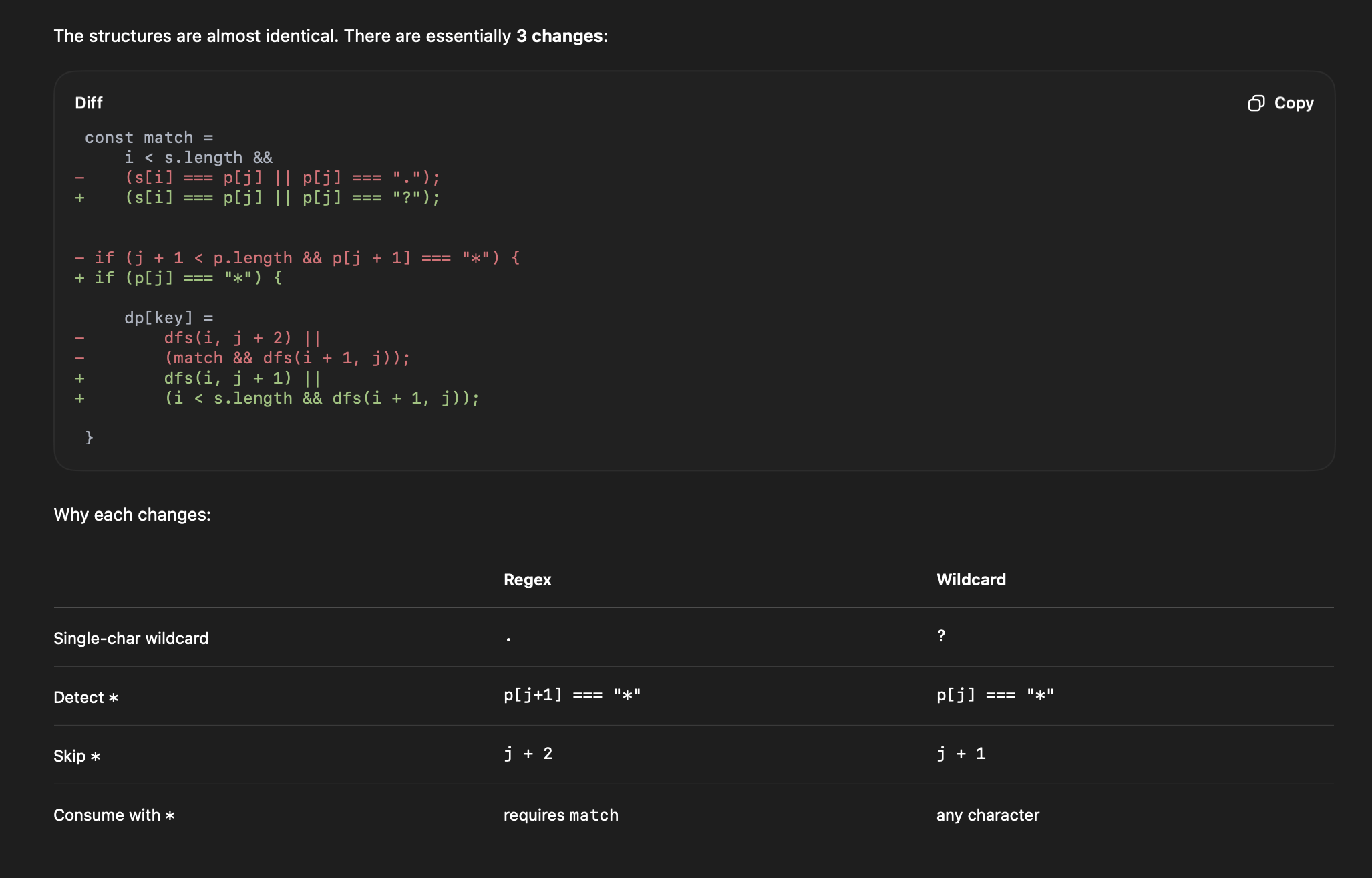
This is the easiest place to get confused.
Wildcard
* = any sequence of charactersTransition:
dfs(i, j + 1) || dfs(i + 1, j)skip * → j + 1
consume → i + 1Regex
* = repeat PREVIOUS elementFor a*:
dfs(i, j + 2) || (match && dfs(i + 1, j))skip a* → j + 2
consume → i + 1Quick memory trick
WILDCARD:  * itself is powerful
REGEX:     character BEFORE * is repeated
Final Cheat Sheet
LCS
match    → 1 + dfs(i+1,j+1)
no match → max(dfs(i+1,j), dfs(i,j+1))


INTERLEAVING
take s1 → dfs(i+1,j)
take s2 → dfs(i,j+1)


DISTINCT SUBSEQUENCES
match    → TAKE + SKIP
no match → SKIP


EDIT DISTANCE
match    → dfs(i+1,j+1)

mismatch →
1 + min(
    insert  → dfs(i,j+1),
    delete  → dfs(i+1,j),
    replace → dfs(i+1,j+1)
)


WILDCARD
normal/? → dfs(i+1,j+1)

* →
skip    → dfs(i,j+1)
consume → dfs(i+1,j)


REGEX
normal/. → dfs(i+1,j+1)

x* →
skip    → dfs(i,j+2)
consume → dfs(i+1,j)
The Common Mental Model
For all six:
              dfs(i, j)
                  |
          Do chars match?
             /        \
           YES         NO
            |           |
      Which pointer   What choices
      should move?    are available?
When you see two strings, string transformation, subsequence matching, or pattern matching, consider a 2D DP state like dfs(i, j) early.