Single source shortest path Ref: https://www.youtube.com/watch?v=FtN3BYH2Zes
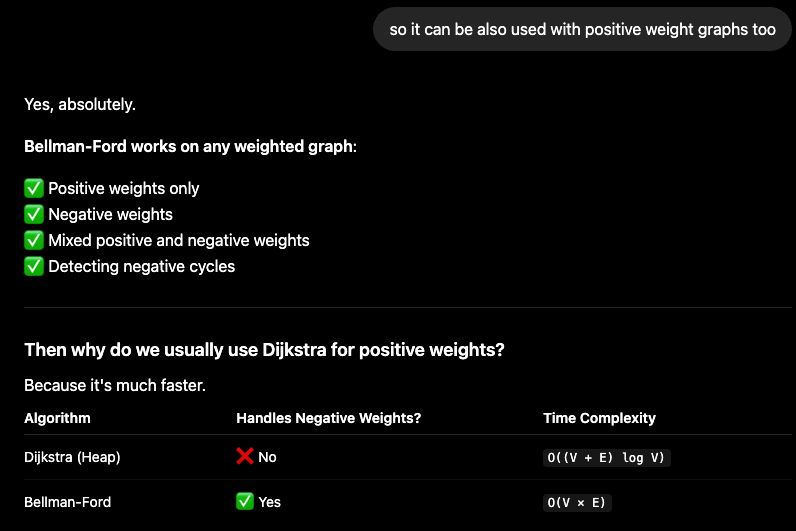
Bellman-Ford finds the shortest path from a source node to every other node in a weighted graph. Unlike Dijkstra, it can handle negative edge weights.
Key
Relax all edges n-1 times (n = number of nodes in graph) Relaxation formula - distance d[v] = min(d[v], d[u] + c[u,v])
Core Idea
Suppose the shortest path can have at most V - 1 edges.
If we repeatedly relax every edge:
dist[v] = min(dist[v], dist[u] + weight)
then after:
- 1st pass → shortest paths using ≤ 1 edge
- 2nd pass → shortest paths using ≤ 2 edges
- …
- (V-1)th pass → all shortest paths found
Why V - 1 Times?
A shortest path never needs more than V - 1 edges.
If a path contains V or more edges, some vertex must repeat, creating a cycle.
dist = [∞, ∞, ..., ∞];
dist[src] = 0;

for (let i = 0; i < V - 1; i++) {
    for (const [u, v, w] of edges) {
        dist[v] = Math.min(dist[v], dist[u] + w);
    }
}
Negative Cycle Detection
Run one more relaxation pass.
If any distance still improves:
dist[v] > dist[u] + w
then a negative cycle exists.
This is Bellman-Ford’s biggest advantage over Dijkstra.
We use a temporary array because each Bellman-Ford iteration should represent paths using one additional edge. The temp array prevents newly relaxed distances from being reused in the same iteration, ensuring that after
iiterations we have only considered paths with at mostiedges.
time: O(V × E) space: O(V)
var findCheapestPrice = function (n, flights, src, dst, k) {
  const INF = Infinity;

  // prices[i] = cheapest cost to reach city i using current allowed edges
  let prices = new Array(n).fill(INF);
  prices[src] = 0;

  // k stops means at most k + 1 flights/edges
  for (let i = 0; i <= k; i++) {
    const temp = [...prices];

    for (const [from, to, cost] of flights) {
      if (prices[from] === INF) continue;

      if (prices[from] + cost < temp[to]) {
        temp[to] = prices[from] + cost;
      }
    }

    prices = temp;
  }

  return prices[dst] === INF ? -1 : prices[dst];
};
When to Think of Bellman-Ford
- Graph has negative weights
- Need negative cycle detection
- Need shortest path with a limited number of edges/stops (like LeetCode 787 Cheapest Flights Within K Stops)
For the cheapest flight path problem, we modify Bellman-Ford slightly:
- Instead of
V-1iterations, - Perform only
k+1iterations, - Use a temporary copy of distances each round,