This is a very common interview question.
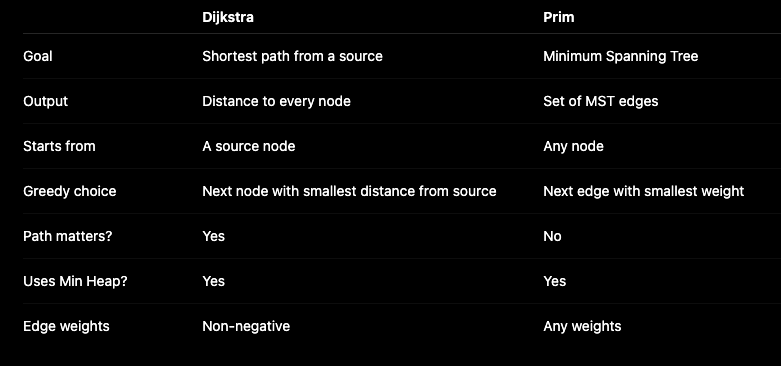
Dijkstra
Find shortest paths from a source.
Example:
A --1-- B
|      /
4     2
|   /
C
From A:
dist(A)=0
dist(B)=1
dist(C)=3   (A->B->C)
We care about:
Shortest distance from sourcePrim
Build a tree connecting all nodes with minimum total cost.
Same graph:
A --1-- B
|      /
4     2
|   /
C
MST:
A --1-- B
B --2-- C

Total cost = 3
We care about:
Minimum total cost to connect everythingNot shortest paths.
Heap Contents
Dijkstra
[distanceFromSource, node]Example:
[5, "C"]means:
Shortest known distance from source to C is 5Prim
[edgeWeight, node]Example:
[5, "C"]means:
Cheapest edge that can add C to the MST costs 5Notice the subtle difference.
Easy Interview Memory Trick
Dijkstra
"How far is this node from the source?"Prim
"What's the cheapest way to connect a new node?"Complexity
With adjacency list + min heap:
Dijkstra: O(E log V)
Prim:     O(E log V)
Microsoft Interview One-Liner
Dijkstra finds shortest paths from one source.
Prim finds the cheapest tree connecting all nodes.