The New York Times 2008 CSRF Attack
In 2008, The New York Times website was found to be vulnerable to a CSRF (Cross-Site Request Forgery) attack, allowing attackers to unsubscribe users from the email newsletter without their consent.
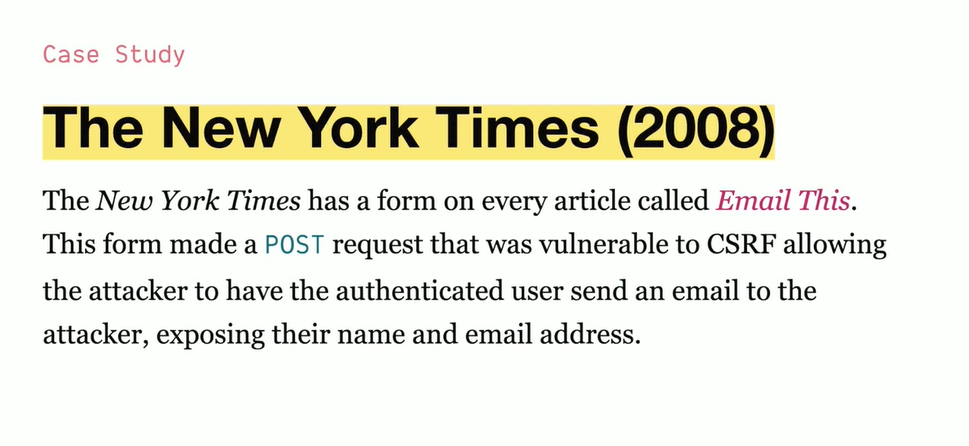
Below one is another attack. Both attacks were CSRF-based vulnerabilities, but the Email This attack leaked user data, whereas the Unsubscribe attack only altered preferences. The “Email This” attack had a higher security impact because it exposed personal information. 🚨
What Was the Vulnerability?
- The New York Times had an unsubscribe feature that used a simple GET request to remove users from their email list.
- No CSRF tokens or authentication were required to verify if the user actually intended to unsubscribe.
- Attackers could force users to unknowingly unsubscribe by embedding malicious links in third-party websites.
How Did the Attack Work?
-
User Was Logged into The New York Times
- The victim had an active session with The New York Times and was subscribed to newsletters.
-
User Visited a Malicious Website
- The attacker hosted a malicious webpage containing an image tag (
<img>) or an invisible iframe (<iframe>). - The webpage automatically sent a forged request to The New York Times.
- The attacker hosted a malicious webpage containing an image tag (
-
Malicious Unsubscribe Request Sent
- The malicious site silently executed:
<img src="https://www.nytimes.com/unsubscribe?email=victim@example.com" /> - Since the victim’s browser automatically included their authentication cookies, The New York Times processed the request as if the user had manually unsubscribed.
- The malicious site silently executed:
-
The User Was Unsubscribed Without Consent
- The victim had no idea that they were removed from the newsletter.
Why Was The New York Times Vulnerable?
-
No CSRF Tokens Used
- The unsubscribe request did not require a CSRF token, making it easy to forge.
-
GET Requests Modified State
- Actions that change user data should never use GET requests.
- The website should have used POST requests with CSRF protection.
-
Cookies Were Automatically Sent
- Since the request was same-origin, browsers automatically included session cookies, making the forged request valid.
Impact of the Attack
- Users were silently unsubscribed from The New York Times newsletters.
- The attack could be automated, affecting thousands of users quickly.
- If extended, this method could have been used for more harmful actions (e.g., account modifications).
How The New York Times Fixed It
✔ Implemented CSRF Tokens:
- Now, users must submit a unique CSRF token with every unsubscribe request.
✔ Switched from GET to POST Requests:
- The unsubscribe action now requires a POST request instead of GET.
✔ Added Confirmation Steps:
- Users now need to confirm their action via a confirmation page before unsubscribing.
✔ Implemented SameSite=Lax Cookies:
- This prevents cookies from being automatically sent in cross-origin requests.
Lessons from The New York Times CSRF Attack
🔹 Always require CSRF tokens for state-changing requests.
🔹 Use POST, not GET, for sensitive actions (e.g., modifying user settings).
🔹 Confirm user actions before executing irreversible changes.
🔹 Monitor unusual traffic patterns to detect CSRF attempts early.
The 2008 New York Times CSRF attack showed how even simple features like an unsubscribe button can become a security risk if not properly secured. 🚀