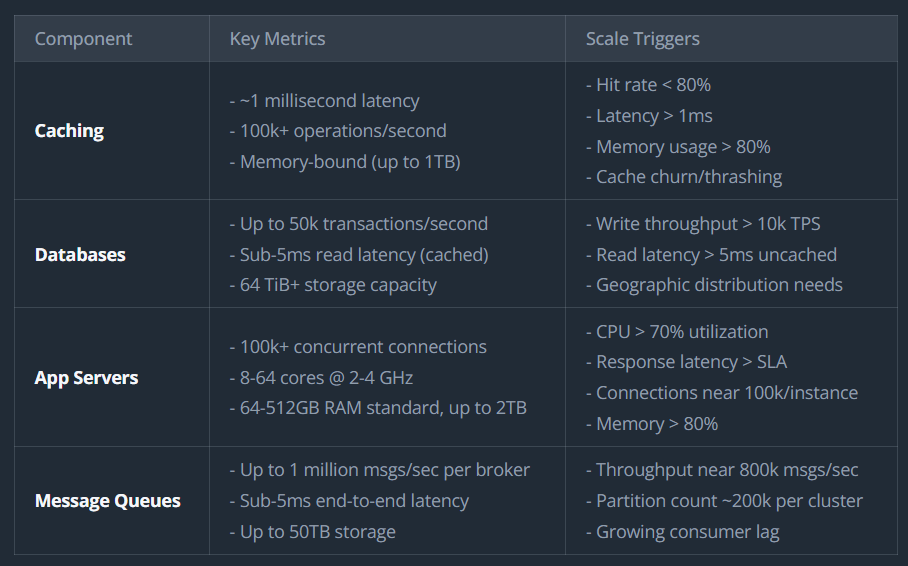
- Modern in-memory caches like Redis can handle over 100,000 operations per second per instance. Understanding this capability helps avoid premature scaling decisions - many systems that seem to need distributed caching can actually run on a single high-performance cache instance.
- In-memory caches like Redis provide sub-millisecond latency by keeping data in RAM, while SSD storage typically provides 5-30ms latency, and other storage types are significantly slower.
- Modern well-tuned database instances can handle 10-20k writes per second.
- Modern single database instances can handle up to 64+ TiB of storage, with some configurations supporting even more.
- Modern high-performance message queues achieve 1-5ms end-to-end latency, making them fast enough to use within synchronous APIs while gaining benefits of reliable delivery and decoupling.
- Modern application servers with optimized configurations can handle over 100,000 concurrent connections per instance. This capability means that connection limits are rarely the first bottleneck - CPU utilization typically becomes the constraint before running out of connection capacity.